#25 Understanding Chinese culture via Chinese characters
Chinese characters are an encapsulation of the values of Chinese culture and such values are able to transmit over generations because of the unbroken Chinese civilisation.

This week’s post is on the significance of Chinese characters with regards to Chinese culture.
I am attaching the below video from the Chinese Central TV (CCTV) programme 《开学第一课》 i.e. "first lesson of the school's new term". I did some English annotation on the video and together with the below explanations, you should be able to understand the Chinese video without much difficulty.
Configuration of Chinese Character
Ca you deduce the meaning of the below Chinese character (circled in red) in the form of its Oracle Bone Script?
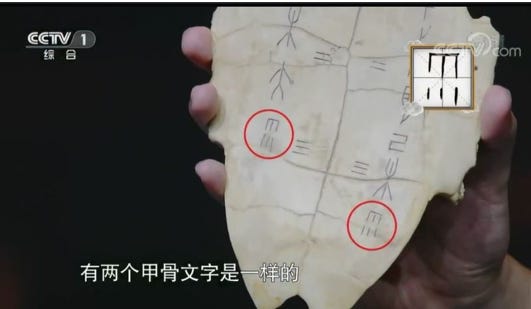
This example helps to illustrate that when ancient Chinese invented these characters, such characters were very visual as they helped to communicate effectively the phenomena and culture during that era. You can find the the answer in the attached video
Indeed, Professor Wang Ning (王宁) of Beijing Normal University (北京师范大学) explains in the video:
我们汉字有几千年的历史, 因为古代的文字要想发展到今天, 中断是非常可能的。 可是汉字呢? 它从一开始,一直走到我们今天没有间断过。
大家想,它这里面会给我们留下来,积下来多少的文化。它会告诉我们多少有趣和有意义的故事。 我们可以直接的去跟我们最早的祖先去对话。
所以大家说我们文化里面的汉字是不是非常值得我们骄傲呢?
Translation:
“Our Chinese characters have a history of a few thousand years, and one should take account that it is very possible that such ancient writing could be discontinued if it has to develop until today.
But what about Chinese characters? It has come a long way from the very beginning to where we are today.
Think of how much culture it has left behind for us, how much culture it has accumulated. How many interesting and meaningful stories it will tell us. We can talk directly to our earliest ancestors.
Therefore don’t you all agree that Chinese characters in our culture are something we should be very proud of?”
She further highlights that the Chinese characters were constructed via the method "因义而构型" i.e. the configuration (构型) of it was due to its meaning (因义).
Therefore the construction of Chinese characters were often set in the context of the social life of the time, and the connection between characters and words was established through the depiction of certain life scenes. Such intricate relationship determines the inevitability of the cultural connection between the construction of the Chinese character and its culture.
Hence Chinese characters are very unique as they encapsulate the values of Chinese culture and because of the unbroken Chinese civilisation for a few thousand years, Chinese cultural values are able to transmit to each generation via Chinese characters and other modes like festivals such as Spring Festival, Mid-Autumn Festival etc.
Transmitting cultural values via Chinese characters - An example
As an illustration, Professor Wang uses 正直 zhèngzhí as an example to illustrate how Chinese characters encapsulate Chinese cultural values.
First let us study 正 and one can see that it is the composition of 止 zhǐ (to stop) with a horizontal line on top.
So how did the ancient Chinese represent 止?
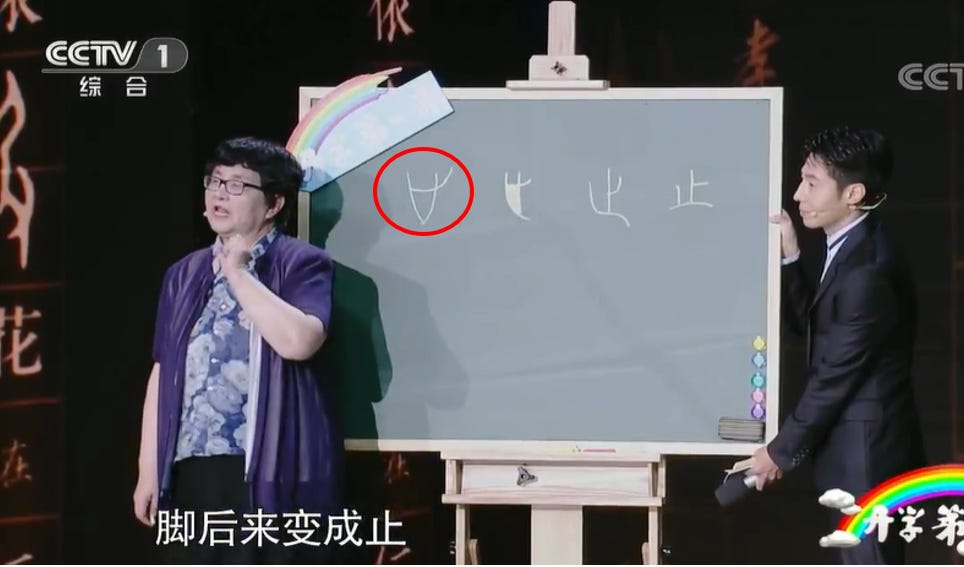
One can see from the above image (taken from the video) that the Oracle Bone Script of 止 depicts a combination of three toes and the sole of the foot.
The no. three was used to represent five by ancient Chinese as it represented a few and was easier to draw, the other example is 又. So the original meaning of 止 means to move. But subsequently it became “to stop” i.e. when one stops moving.
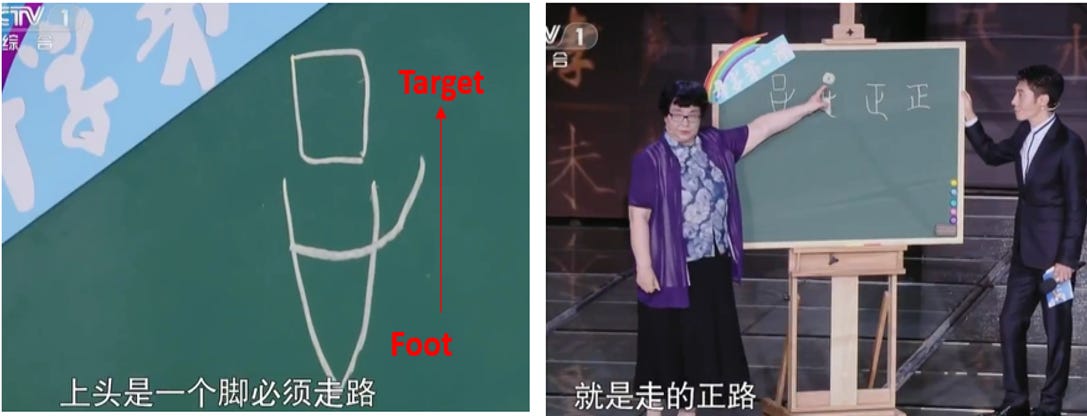
So what is the meaning of the top horizontal line above 止? It is actually the target one wants to reach since the bottom represents the foot (see above). So the original meaning of 正 had the meaning of walking in the right direction (走的正路).
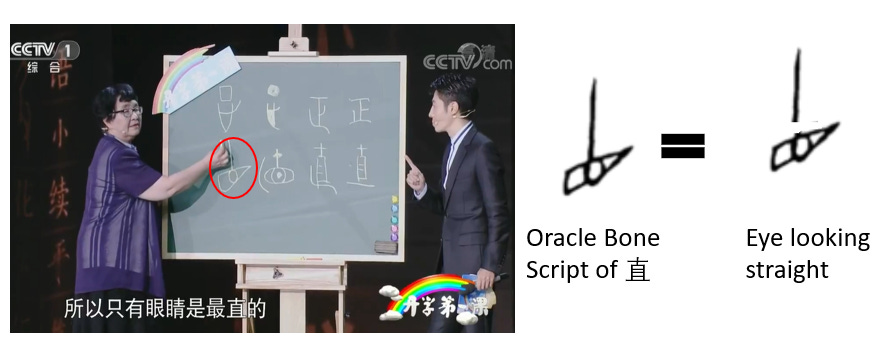
For 直 , it was initally an eye that was looking forward in a straight direction and subsequently the eye was inverted and some lines were added to it (see above).
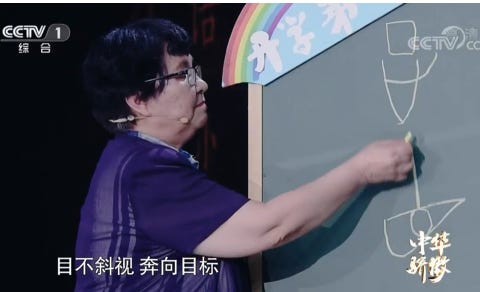
So the original meaning of 正直 is “目不斜视,奔向目标” which means eyes looking straight without squinting and head for the goal.
Of course, it has been inferred as upright, honest etc. now which is an extension of its the original meaning and it reflects the cultual values of the Chinese that have been established since ancient times.
Attached is the video.